VQkit Logo

Getting Started

  • Overview
    • Design concept
    • Unified interface
    • File-based architecture
    • Modular workflow design
    • User control
    • Local and HPC workflows
    • Extensibility
    • Scope
  • Features
    • Pre-processing
      • Structure and input preparation
      • Pseudopotentials
      • Brillouin-zone sampling
      • Convergence workflows
      • Reaction pathways and dynamics
    • Post-processing
      • General calculation analysis
      • Structural analysis
      • Electronic structure
      • Charge, localization, and bonding
      • Energetics and thermodynamics
      • AIMD and trajectory analysis
      • Mechanical and structural materials analysis
      • Phonon-derived transport descriptors
    • Application-oriented analysis
    • VASP and Quantum ESPRESSO support
    • Output and visualization
  • Installation
    • Requirements
    • Recommended installation
    • Windows
    • Linux
    • Linux / HPC
    • Verify installation
    • Install from source
    • Development installation
    • Updating VQkit
    • Uninstalling VQkit
    • Troubleshooting
      • Command not found
      • Python version
      • Package information
      • Reinstall if necessary

Tutorials

  • Tutorials
    • Start here
    • Electronic-structure tutorials
    • Charge and bonding tutorials
    • Dynamics and reaction-path tutorials
    • Tutorial index
      • Input Generation
        • Important
        • Open the Pre-processing menu
        • 1. Create a new calculation
        • VASP input generation
        • VASP KPOINTS
        • VASP POSCAR and POTCAR
        • VASP generated directory
        • Quantum ESPRESSO input generation
        • QE directory structure
        • Editing QE starter inputs
        • QE prerequisite stages
        • 2. Convert CIF to input
        • 3. Convert output to input
        • Structure editing
        • Pre-flight input validation
        • Example: VASP SCF starter
        • Example: QE DOS starter
        • Recommended workflow
        • Scientific cautions
      • Band Structure
        • Typical workflow
        • High-symmetry K-path preparation
        • Symmetry path menu
        • Symmetry tolerance
        • K-point density along the path
        • Generated K-path files
        • Band calculation: VASP
        • Band calculation: Quantum ESPRESSO
        • Band-structure analysis
        • Band report
        • Generated outputs
        • VASP example
        • Quantum ESPRESSO example
        • Band-gap analysis
        • Recommended workflow
        • Scientific cautions
      • DOS and PDOS
        • Open the electronic-structure menu
        • DOS workflow
        • Running DOS analysis
        • DOS report
        • Fermi-level reference
        • Spin-polarized DOS
        • DOS outputs
        • Example: VASP DOS
        • Quantum ESPRESSO DOS example
        • PDOS workflow
        • VASP requirements for PDOS
        • Quantum ESPRESSO requirements for PDOS
        • Running PDOS analysis
        • Atom selection
        • Orbital-group selection
        • p-orbital components
        • d-orbital components
        • PDOS report
        • PDOS output naming
        • PDOS data export
        • Spin-polarized PDOS plot
        • Example: VASP atom-resolved d-PDOS
        • Example: Quantum ESPRESSO projected DOS
        • Orbital interpretation
        • Common problems
        • Recommended DOS/PDOS workflow
        • Scientific cautions
      • Work Function
        • Open the work-function workflow
        • VASP workflow
        • Generating LOCPOT
        • Choose the slab-normal axis
        • Planar averaging of LOCPOT
        • Vacuum regions
        • Work-function calculation
        • VASP output report
        • Generated files
        • Work-function plot
        • Vacuum-flatness warning
        • Example: VASP slab
        • Quantum ESPRESSO workflow
        • QE Fermi energy
        • No QE planar profile found
        • QE pp.x input
        • QE saved data
        • QE average.x input
        • Automatic QE execution
        • Manual QE execution
        • QE unit handling
        • QE work-function calculation
        • Example: QE slab
        • Symmetric versus asymmetric slabs
        • Common problems
        • Scientific cautions
      • Charge-Density Difference
        • Important
        • Typical input
        • Open the CDD workflow
        • Cube-file information
        • Plot menu
        • 1. XY center slice
        • 2. XZ center slice
        • 3. YZ center slice
        • 4. All center slices
        • 5. Custom slice position
        • 6. Planar average along z
        • Color convention
        • Atomic overlays
        • Example: adsorption-system CDD
        • Generating the final QE CDD cube
        • 3D visualization
        • Interpreting CDD
        • Common problems
        • Scientific cautions
      • Electron Localization Function
        • Important
        • Open the ELF workflow
        • Existing ELF cube
        • No ELF cube found
        • Cube information
        • Plot menu
        • 1. XY center slice
        • 2. XZ center slice
        • 3. YZ center slice
        • 4. All center slices
        • 5. Custom slice position
        • ELF data files
        • Atomic overlays
        • Contour levels
        • Interpreting ELF
        • Example: bonding analysis
        • Example: Quantum ESPRESSO workflow
        • 3D visualization
        • Common problems
        • Scientific cautions
      • Bader Charge Analysis
        • Important
        • Typical required files
        • Open the Bader menu
        • 1. Check the executable and files
        • 2. Prepare the reference density
        • 3. Run Bader analysis
        • 4. Analyze an existing ACF.dat
        • Output file
        • Meaning of the columns
        • Example interpretation
        • Complete example workflow
        • Existing ACF.dat example
        • Common problems
        • Scientific cautions
      • AIMD / Trajectory Analysis
        • Required files
        • Open the AIMD menu
        • Time convention
        • Variable-cell trajectories
        • 1. Trajectory summary
        • 2. Atomic positions versus time
        • 3. Energy versus time
        • 4. Volume and lattice parameters versus time
        • 5. Bond distance versus time
        • 6. Mean-squared displacement
        • 7. Diffusion coefficient
        • 8. Radial distribution function
        • 9. Coordination number versus time
        • Example: Li-ion AIMD analysis
        • Recommended AIMD workflow
        • Scientific cautions
      • NEB / Transition-State Analysis
        • Important
        • Before starting
        • Open NEB image generation
        • VASP NEB preparation
        • VASP production setup
        • Quantum ESPRESSO NEB preparation
        • QE CIF inspection images
        • Running QE NEB
        • NEB post-processing
        • Expected directory layout
        • VASP energy detection
        • Quantum ESPRESSO energy detection
        • Mixed-code profiles
        • Relative-energy profile
        • Transition-state candidate
        • Forward activation barrier
        • Reverse activation barrier
        • Reaction energy
        • Generated NEB outputs
        • Example: VASP diffusion pathway
        • Example: QE NEB workflow
        • Common problems
        • Scientific cautions

Pre-processing

  • Pre-processing
    • Calculation Setup
      • Main setup workflows
      • Create a new calculation
        • VASP
        • Quantum ESPRESSO
      • CIF to input
      • Output to input
      • VASP setup checks
      • Quantum ESPRESSO setup checks
      • Pre-flight validation
      • Related pages
        • Input Generation
        • Reciprocal Space and Convergence
        • Pseudopotentials
        • Validation
        • Structure Editing
        • NEB Pre-processing
    • Structure Editing
      • Height and layer analysis
      • Layer detection
      • Supported input structures
        • VASP
        • Quantum ESPRESSO
      • [4] Freeze / fix atoms
        • VASP example
        • Quantum ESPRESSO example
      • Choose fixed direction
        • Examples
      • How VQkit represents constraints
        • VASP
        • Quantum ESPRESSO
      • Selecting atoms to fix
      • Selection by height
        • Example
        • Custom height
      • Selection by layers
      • Selection by atom index
      • Output file for freeze/fix workflow
        • VASP
        • Quantum ESPRESSO
      • Existing output protection
      • QE atom ordering and mapping
      • Example: freeze bottom two VASP layers
        • Step 1
        • Step 2
        • Step 3
        • Step 4
        • Step 5
        • Step 6
        • Step 7
      • Example: fix only z motion in QE
        • Step 1
        • Step 2
        • Step 3
        • Step 4
        • Step 5
      • [5] Delete atoms
        • Quantum ESPRESSO
        • VASP
      • Selecting atoms to delete
      • Selection by atom label/type
      • Selection by layers
      • Selection by height
      • Deletion summary
      • Delete-atoms output files
        • VASP
        • Quantum ESPRESSO
      • VASP deletion behavior
      • Quantum ESPRESSO deletion behavior
      • Example: remove an adsorbate
        • Step 1
        • Step 2
        • Step 3
        • Step 4
        • Step 5
        • Step 6
        • Step 7
      • Example: remove the top slab layer
        • Step 1
        • Step 2
        • Step 3
        • Step 4
        • Step 5
      • Important scientific checks after editing
        • After deletion
        • After freezing
      • Height-based selection cautions
      • Layer tolerance
      • Recommended workflow
    • Validation
      • Meaning of report levels
        • OK
        • WARNING
        • ERROR
        • INFO
      • Code detection
      • VASP pre-flight validation
      • INCAR checks
        • ENCUT
        • EDIFF
      • Repeated INCAR tags
      • Spin setup
      • Ionic-relaxation consistency
      • POSCAR checks
        • Cell volume
        • Species information
        • Selective dynamics
      • POTCAR checks
        • POSCAR versus POTCAR species order
        • POTCAR variants
      • ENCUT versus ENMAX
      • KPOINTS validation
        • Automatic mesh
        • Line mode
        • Explicit k points
      • HPC job script
      • VASP example report
      • Quantum ESPRESSO pre-flight validation
      • Required QE namelists
        • ELECTRONS namelist
      • nat and ntyp
      • ATOMIC_SPECIES
      • ATOMIC_POSITIONS
      • Lattice validation
      • Plane-wave cutoffs
      • K_POINTS validation
        • Automatic mesh
        • Band-structure path
      • Relaxation-specific checks
      • Smearing consistency
      • Calculation identity
      • pseudo_dir validation
      • Pseudopotential file validation
      • outdir
      • QE example report
      • READY logic
        • READY
        • READY WITH WARNINGS
        • NOT READY
      • What the checker does not validate
      • Recommended workflow
      • Scientific responsibility
    • Pseudopotentials
      • Why pseudopotential configuration matters
      • [8] Pseudopotential library setup
      • 1. Configure VASP POTCAR library
        • How VQkit finds a VASP library
        • Typical VASP library layouts
        • Exact element versus variant
      • 2. Configure Quantum ESPRESSO UPF library
        • QE pseudopotential availability
      • 3. Show configured pseudopotential libraries
      • 4. VQkit private pseudopotential folders
      • VASP licensing note
      • [7] Create POTCAR from POSCAR
        • Required file
        • Reading species information
        • Using a previously configured library
      • POTCAR assembly
      • Missing potential
      • Existing POTCAR
      • Automatic POTCAR creation during calculation setup
      • Example: VASP Fe-O calculation
        • Step 1 — Open Pre-processing
        • Step 2 — Create POTCAR
        • Step 3 — Confirm detected species
        • Step 4 — Select the local library
        • Step 5 — Resolve variants if necessary
        • Step 6 — Inspect the result
        • Step 7 — Run pre-flight validation
      • POTCAR and ENCUT
      • Example: Quantum ESPRESSO library setup
        • Step 1 — Open library setup
        • Step 2 — Select QE
        • Step 3 — Enter the path
        • Step 4 — Verify status
        • Step 5 — Use it in QE setup
      • Scientific selection of pseudopotentials
        • Exchange-correlation functional
        • Valence configuration
        • Spin-orbit coupling
        • Consistency across comparative calculations
        • Cutoff convergence
      • Common problems
        • VASP library not configured
        • Wrong directory level
        • POTCAR variant not selected
        • Missing QE UPF file
        • POSCAR species order changed
        • Existing POTCAR overwritten unintentionally
      • Licensing and redistribution
        • VASP
        • Quantum ESPRESSO
      • Recommended workflow
    • Reciprocal Space and Convergence
      • [9] Generate band-structure K-path
        • Supported structure sources
      • Symmetry tolerance scan
        • Why symprec matters
      • Symmetry-standardized path
      • Interpolation density
      • VASP path output
      • Quantum ESPRESSO path output
      • Built-in fallback path library
        • Simple cubic
        • Primitive FCC
        • Primitive BCC
        • Hexagonal
      • Band-path cautions
      • [10] K-points
      • Supported structures
        • VASP
        • Quantum ESPRESSO
      • Reciprocal lattice
      • Automatic k-spacing
      • Mesh formula
      • System dimensionality
      • Vacuum-gap estimation
      • Automatic dimensionality
      • 2D systems
      • 1D systems
      • 3D systems
      • Monkhorst-Pack mesh
      • Gamma-centered mesh
        • VASP output
        • Quantum ESPRESSO output
      • QE Monkhorst-Pack shifts
      • Irreducible k-points
        • VASP
        • Quantum ESPRESSO
      • Manual k-point mesh
      • K-point scientific cautions
        • Mesh density
        • Metals
        • DOS
        • Low-dimensional systems
        • Supercells
      • [11] Convergence tests
      • VASP cutoff preparation
        • Required files
        • Cutoff values
        • Output directory
      • Quantum ESPRESSO cutoff preparation
        • Default ecutwfc values
        • ecutrho ratio
        • Output structure
      • Execution modes
        • Prepare only
        • Generate HPC scripts
        • Run directly
      • Analyze completed cutoff calculations
      • Energy extraction
        • VASP
        • Quantum ESPRESSO
      • Reference energy
      • Recommended cutoff logic
      • Generated convergence outputs
      • Example: VASP cutoff convergence
        • Step 1
        • Step 2
        • Step 3
        • Step 4
        • Step 5
        • Step 6
        • Step 7
        • Step 8
      • Example: QE cutoff convergence
        • Step 1
        • Step 2
        • Step 3
        • Step 4
        • Step 5
        • Step 6
        • Step 7
        • Step 8
      • Convergence-test cautions
        • Only one parameter at a time
        • Geometry
        • Pseudopotential dependence
        • Property dependence
        • K-point convergence
      • Recommended workflow
    • NEB Pre-processing
      • NEB concept
      • Open the NEB image generator
      • VASP NEB preparation
        • Final structure
        • Number of intermediate images
        • Output folder
      • VASP endpoint requirements
      • VASP interpolation cautions
      • Recommended VASP workflow
      • Quantum ESPRESSO NEB preparation
        • Endpoint inputs
        • Endpoint consistency
        • Intermediate-image count
      • QE NEB output file
      • QE CIF inspection images
      • Visual validation
      • What to inspect in every image
      • QE execution
      • Review before running QE NEB
      • Climbing-image NEB
      • Number of images
        • Too few images
        • Too many images
      • Cell consistency
      • Periodic boundary conditions
      • Atom ordering
      • Endpoint optimization
      • VASP preparation after interpolation
      • Quantum ESPRESSO preparation after interpolation
      • NEB convergence
      • Transition-state interpretation
      • Recommended VASP example
        • Step 1
        • Step 2
        • Step 3
        • Step 4
        • Step 5
        • Step 6
        • Step 7
        • Step 8
        • Step 9
      • Recommended QE example
        • Step 1
        • Step 2
        • Step 3
        • Step 4
        • Step 5
        • Step 6
        • Step 7
        • Step 8
        • Step 9
        • Step 10
      • Connection to NEB post-processing
      • Scientific cautions
      • Recommended workflow

Post-processing

  • Post-processing
    • General Calculation Analysis
      • Example
      • Basic workflow
        • Step 1 — Enter the calculation directory
        • Step 2 — Open Post-processing
        • Step 3 — Choose General calculation analysis
      • Information reported
      • Code detection
        • VASP detection
        • Quantum ESPRESSO detection
        • Possible code labels
      • Calculation-type detection
        • VASP calculation types
        • Quantum ESPRESSO calculation types
      • VASP status detection
        • Completed
        • Converged / finalization not detected
        • Running or incomplete
        • No completed calculation detected
      • Quantum ESPRESSO status detection
        • QE XML sources
        • XML completion status
        • QE text-output status
      • Input/output association
      • VASP total-energy extraction
        • Meaning of the VASP energy
      • Quantum ESPRESSO total-energy extraction
      • VASP Fermi-level extraction
      • Quantum ESPRESSO Fermi-level extraction
      • Example: completed VASP SCF
      • Example: completed QE SCF
      • Example: incomplete calculation
      • Interpreting the status correctly
        • Completed
        • Converged / finalization not detected
        • Running or incomplete
        • Failed
      • Mixed directories
      • Why the summary is useful
      • Recommended post-processing sequence
      • Scientific cautions
        • Completion is not convergence
        • Last energy is not always the desired energy
        • Cross-code energy comparison
        • Fermi level interpretation
      • Summary limitations
      • Recommended practice
    • Structural Analysis
      • Overview
      • VASP example
      • Quantum ESPRESSO example
      • Final-structure detection
        • VASP
        • Quantum ESPRESSO
      • Optimized structure / lattice / volume
        • Lattice-vector lengths
        • Cell angles
        • Cell volume
        • Representative output
      • Converting the final structure to a new input
      • Bond-length analysis
        • Periodic boundary conditions
        • Distance calculation
        • Representative output
        • CSV output
      • Choosing a bond cutoff
      • Bond-angle analysis
        • Geometry
        • Representative output
        • CSV output
      • Atomic-height analysis
        • Projected coordinate
        • Representative output
        • CSV output
      • Layer analysis
        • Clustering logic
        • Representative output
        • CSV output
      • Using layer analysis for slab systems
      • Choosing the layer tolerance
      • Example: analyze a relaxed VASP slab
        • Step 1
        • Step 2
        • Step 3
        • Step 4
        • Step 5
        • Step 6
      • Example: analyze a relaxed QE structure
      • Minimum-image convention
      • Scientific cautions
        • Geometric cutoff is not a bond definition
        • Bond angles depend on the cutoff
        • Layer analysis assumes a-b is the surface plane
        • Final structure may not be converged
        • Cell changes matter
      • Recommended workflow
      • Generated files
    • Electronic Structure
      • General workflow
      • DOS - VASP
        • Energy reference
        • VASP DOS outputs
      • DOS - Quantum ESPRESSO
      • Projected DOS (PDOS)
        • Atom selection
        • Orbital groups
        • Spin-resolved PDOS
        • PDOS output filenames
      • Band structure - VASP
        • High-symmetry labels
      • Band structure - Quantum ESPRESSO
      • Band outputs
      • Spin-polarized bands
      • Band-gap analysis
        • Required data
        • Metallic / gapless classification
        • Semiconductor / insulator analysis
        • Direct gap
        • Representative output
        • Band-gap output
      • Band-gap cautions
      • Fermi energy
        • VASP
        • Quantum ESPRESSO
        • Representative output
      • Work function
        • VASP work function
        • Vacuum windows
        • Vacuum-flatness warning
      • Quantum ESPRESSO work function
        • QE potential units
      • Work-function outputs
      • Relationship between the six menu items
        • DOS
        • PDOS
        • Band structure
        • Band gap
        • Fermi energy
        • Work function
      • Recommended analysis sequence
      • Common cautions
        • Fermi-energy alignment
        • Spin polarization
        • DOS versus band gap
        • Band path
        • Work function
      • Generated files summary
        • DOS
        • PDOS
        • Band structure
        • Band gap
        • Work function
    • Charge Density, Bader Charge, and ELF
      • Charge-density difference
        • Preferred CDD filenames
        • No cube file found
      • CDD cube parsing
        • Density units
      • CDD plotting menu
        • Center slices
        • Custom slice
        • Planar average
      • CDD color convention
      • CDD outputs
      • Three-dimensional visualization
      • CDD interpretation cautions
      • Bader charge analysis
      • External dependency
      • Bader file-status check
      • Reference-density preparation
      • Running Bader analysis
        • Reference-density selection
      • Analyzing an existing ACF.dat
      • POTCAR ZVAL and net charge
        • Example
      • Bader output
      • Additional ACF information
      • Bader interpretation cautions
      • Electron localization function
        • Preferred filenames
      • ELF range
      • ELF plotting menu
        • Custom ELF slice
      • ELF contours
      • QE ELF preparation
      • ELF outputs
      • Three-dimensional ELF
      • Relationship between CDD, Bader, and ELF
        • CDD
        • Bader charge
        • ELF
      • Recommended combined workflow
      • Tutorial links
    • Energetics and Thermodynamics
      • Detected calculation and status
      • [1] Atom / molecule adsorption energy
        • General adsorption-energy expression
        • Isolated-atom reference
        • Molecular reference for atomic adsorption
        • Intact molecular adsorption
        • Adsorption-energy output
        • Adsorption-energy cautions
      • [2] Doping formation energy
        • Substitutional doping
        • Interstitial doping
        • Doping output
        • Chemical-potential caution
      • [3] NEB / transition-state analysis and plot
        • Expected directory layout
        • VASP image energies
        • Quantum ESPRESSO image energies
        • Mixed-code image sets
        • Relative energy
        • Transition-state candidate
        • Forward activation barrier
        • Reverse activation barrier
        • Reaction energy
        • NEB outputs
        • NEB scientific caution
      • [4] Surface energy
        • Surface treatment
        • Surface area
        • Energy inputs
        • Surface-energy units
        • Surface-energy output
        • Symmetric versus asymmetric slabs
      • [5] Single-atom vacancy formation energy
        • Vacancy output
        • Vacancy-energy caution
      • Common requirements for energetic comparisons
      • Energy versus free energy
      • Recommended workflow
      • Generated files summary
        • Adsorption
        • Doping
        • NEB
        • Surface energy
        • Vacancy
    • AIMD / Trajectory Analysis
      • General AIMD requirements
      • Time-step detection
      • Time convention
      • Variable-cell / NPT trajectories
      • Common XDATCAR prompt
      • Coordinate handling
      • Periodic unwrapping
      • [1] Trajectory summary
        • Output directory
        • Representative summary
      • [2] Atomic position coordinates vs time
        • Atom selection
        • Coordinate output
        • Output directory
        • Why unwrapped coordinates matter
      • [3] Energy vs time
        • OSZICAR parsing
        • OUTCAR fallback
        • Output directory
        • Scientific interpretation
      • [4] Volume / lattice parameters vs time
        • Output directory
      • [5] Bond distance vs time
        • Output directory
      • [6] Mean-square displacement (MSD)
        • Atom selection
        • MSD definition
        • Output directory
        • Variable-cell caution
      • [7] Diffusion coefficient
        • Einstein relation
        • Dimensionality
        • Fit range
        • Diffusion coefficient
        • Fit quality
        • Output directory
        • Diffusion-analysis caution
      • [8] Radial distribution function (RDF)
        • RDF definition
        • Maximum radius
        • Bin width
        • Output directory
        • RDF interpretation
      • [9] Coordination number vs time
        • Frame statistics
        • Output directory
        • Coordination cutoff
      • Atom and group selection
        • Position analysis
        • Group analyses
      • Example: Li-ion diffusion
        • Step 1
        • Step 2
        • Step 3
        • Step 4
        • Step 5
        • Step 6
        • Step 7
        • Step 8
      • Example: bond-breaking trajectory
      • Example: liquid structure
      • Output directory summary
        • Trajectory summary
        • Atomic positions
        • Energy
        • Cell / volume
        • Bond distance
        • MSD
        • Diffusion
        • RDF
        • Coordination
      • Plot generation
      • Important scientific cautions
        • Equilibration
        • Temperature stability
        • Trajectory length
        • Finite-size effects
        • Time-step choice
        • Variable-cell effects
        • Diffusion regime
      • Recommended AIMD analysis sequence
    • Batteries
      • Cathode material analysis
        • [1] Average Li insertion voltage
        • [2] Theoretical specific capacity
        • [3] Lithiation formation / tie-line energy
        • [4] Volume change on lithiation / delithiation
        • [5] Ideal specific-energy estimate
        • [6] Dilute-limit Li diffusivity estimate
        • [7] Cathode equations and reference
      • Anode material analysis
        • [1] Anode theoretical specific capacity
        • [2] Average Li intercalation voltage / OCV
        • [3] Carbon-anode formation energy
        • [4] Volume expansion on lithiation
        • [5] Li diffusion-barrier summary
        • [6] Anode equations and scientific notes
      • Chemical-formula mass parser
      • Reference consistency
      • Li metal reference
      • Formula-unit normalization
      • 0 K approximation
      • Cathode stability versus full phase stability
      • Diffusion caution
        • Cathode
        • Anode
      • Recommended cathode workflow
      • Recommended anode workflow
      • Connection to other VQkit modules
        • NEB
        • AIMD diffusion
        • Electronic structure
        • Structural changes
      • Current scope
      • Summary
        • Cathodes
        • Anodes
    • Catalysis
      • Computational hydrogen electrode
      • [1] ORR free-energy analysis (CHE)
        • Input modes
        • Adsorption free energies
        • CHE step spans
        • Limiting potential
        • ORR outputs
      • [2] OER free-energy analysis (CHE)
      • ORR/OER free-energy diagrams
      • [3] HER analysis
        • DFT adsorption energy
        • Thermochemical correction
        • Interpretation
        • HER outputs
      • [4] CO2RR analysis
        • CO pathway
        • Formate pathway
        • Potential and pH corrections
        • Limiting potential
      • [5] NRR analysis (CHE)
        • Incremental free energies
        • NRR outputs
        • Custom NRR pathway
      • [6] CO reduction (CORR) analysis
      • [7] Vibrational frequency analysis
        • Supported sources
        • Mode classification
        • Zero-point energy
        • Finite-temperature vibrational terms
        • Low-frequency cutoff
        • Outputs
        • Imaginary-mode caution
      • [8] Orbital center (s/p/d)
        • Spin-polarized calculations
        • Integration windows
        • Atom selection
        • Required VASP data
        • Output
        • Current backend scope
        • Comparison rule
      • Catalysis workflow relationships
        • Electronic structure
        • Charge and bonding
        • Reaction barriers
        • AIMD
      • Recommended ORR/OER workflow
      • Recommended HER workflow
      • Recommended CO2RR workflow
      • Recommended NRR/CORR workflow
      • Thermochemistry consistency
      • Scientific limitations
      • Summary
    • Mechanical / Structural Properties
      • Elastic tensor
      • Voigt strain convention
      • Default strain grid
      • [1] Prepare elastic calculations
      • Source structures
      • Metric lattice-family detection
      • General elastic mode
      • Symmetry-reduced mode
      • Energy-strain method
        • Energy-strain physics
      • VASP preparation
      • Quantum ESPRESSO preparation
      • Output directories
      • Manifest file
      • Stress-strain method
      • Stress-strain accuracy
      • [2] Analyze completed elastic calculations
      • Energy-strain fitting
      • Stress-strain fitting
      • Raw stress stiffness tensor
      • Elastic stiffness tensor
      • Compliance tensor
      • Voigt-Reuss-Hill properties
        • Young’s modulus
        • Poisson ratio
        • Pugh ratio
      • Elastic anisotropy
      • Mechanical stability
      • Mechanical output summary
      • [3] Directional elasticity: high-accuracy 3D plots
        • Input sources
      • Positive-definite requirement
      • Young’s modulus
      • Linear compressibility
      • Shear modulus
      • Poisson ratio
      • High-resolution grid
      • ELATE-compatible optimization
      • Automatic directional extrema
      • Directional output directory
      • Directional summary
      • Recommended elastic workflow
      • Energy-strain versus stress-strain
        • Energy-strain
        • Stress-strain
      • Scientific cautions
        • Small-strain regime
        • Internal relaxation
        • Symmetry
        • Convergence
        • Stability
      • Summary
    • Phonon-Derived Transport Properties
      • [1] Phonon group velocity
      • Supported dispersion-table formats
        • Phonopy band.dat
        • Rectangular table
        • Simple branch-block table
      • Source-unit selection
      • Group-velocity conversion
      • Segment-aware differentiation
      • Branch-resolved velocities
      • Acoustic-mode estimate near Gamma
        • Representative output
      • Acoustic RMS velocity
      • Group-velocity cautions
      • [2] Gruneisen parameter
        • Gruneisen menu
      • [1] gruneisen_band.dat
      • Acoustic RMS Gruneisen parameter
      • Two-volume Gruneisen calculation
      • Non-positive frequencies
      • Folder-based workflow
      • Volume-span warning
      • Gruneisen outputs
      • Scientific interpretation
      • [3] Debye temperature
      • Automatic Debye workflow
        • Acoustic velocity
        • Structure detection
      • Velocity-based Debye temperature
      • Automatic Debye output
      • Maximum-frequency estimate
      • Manual acoustic-velocity mode
      • Relationship among the three descriptors
        • Group velocity
        • Gruneisen parameter
        • Debye temperature
      • Recommended workflow
      • Scientific cautions
        • Phonon stability
        • q-path dependence
        • Acoustic fitting
        • Volume perturbation
        • Branch correspondence
        • Debye-model limitation
        • Thermal conductivity
      • Generated files summary
        • Group velocity
        • Acoustic Gruneisen RMS
        • Mode-resolved Gruneisen parameter
        • Debye temperature
      • Summary
    • Supercapacitor
      • [1] Quantum capacitance from DOS
      • DOS source
        • VASP
        • Quantum ESPRESSO
      • Spin-polarized DOS
      • Fermi-Dirac derivative
      • Effective DOS
      • Area conversion
      • Electrode-area input
        • Automatic structure detection
        • Manual area
      • Temperature
      • Potential modes
        • Single potential
        • Potential range
      • Potential-dependent output
      • Quantum-capacitance summary
      • Plots
      • Low-temperature limit
      • Example quantum-capacitance workflow
        • Step 1
        • Step 2
        • Step 3
        • Step 4
        • Step 5
        • Step 6
        • Step 7
        • Step 8
      • [2] Total interfacial capacitance
      • Input
      • Physical interpretation
      • [3] Show equations / conventions
      • Quantum capacitance versus double-layer capacitance
        • Quantum capacitance
        • Double-layer capacitance
      • DOS convergence
      • Energy window
      • Electrode area
      • One-sided versus two-sided electrodes
      • Potential convention
      • Temperature dependence
      • Supercapacitor limitations
      • Pseudocapacitive materials
      • Recommended workflow
      • Connection to other VQkit modules
        • Electronic DOS
        • Structural area
        • Charge redistribution
      • Generated files summary
        • Quantum capacitance data
        • Quantum capacitance summary
        • Potential-dependent plot
      • Summary

Reference

  • Gallery
    • Pre-processing examples
      • Calculation preparation
        • VASP calculation setup
        • Quantum ESPRESSO calculation setup
      • Band-structure preparation
      • NEB preparation
    • Post-processing examples
      • General calculation analysis
      • Structural analysis
    • Electronic structure
      • Density of states
      • Band structure
      • Work function
    • Additional gallery topics
  • Resources
    • Electronic-structure software
      • VASP
      • Quantum ESPRESSO
    • Scientific Python ecosystem
      • NumPy
      • SciPy
      • Matplotlib
      • spglib
      • SeeK-path
    • Related tools
    • Pseudopotential resources
    • Documentation resources
    • Licensing and citation
  • Citation
  • Downloads
    • Current release
      • VQkit 1.1
        • Recommended installation package
        • Installable wheel
        • Source distribution
        • Source ZIP
        • Complete software package
    • Package selection
    • Official download location
    • Verification
  • Release Notes
    • VQkit 1.0
  • Acknowledgments
    • Electronic-structure software
    • Scientific Python ecosystem
    • Development and testing
    • Community
    • Citation and third-party software
VQkit
  • Gallery

Gallery

The VQkit Gallery presents selected examples of calculation preparation, analysis workflows, and graphical outputs produced through VQkit.

The examples below are intended to illustrate the types of workflows and results available in the toolkit. Detailed instructions are provided in the Tutorials, Pre-processing, and Post-processing sections.

Pre-processing examples

Calculation preparation

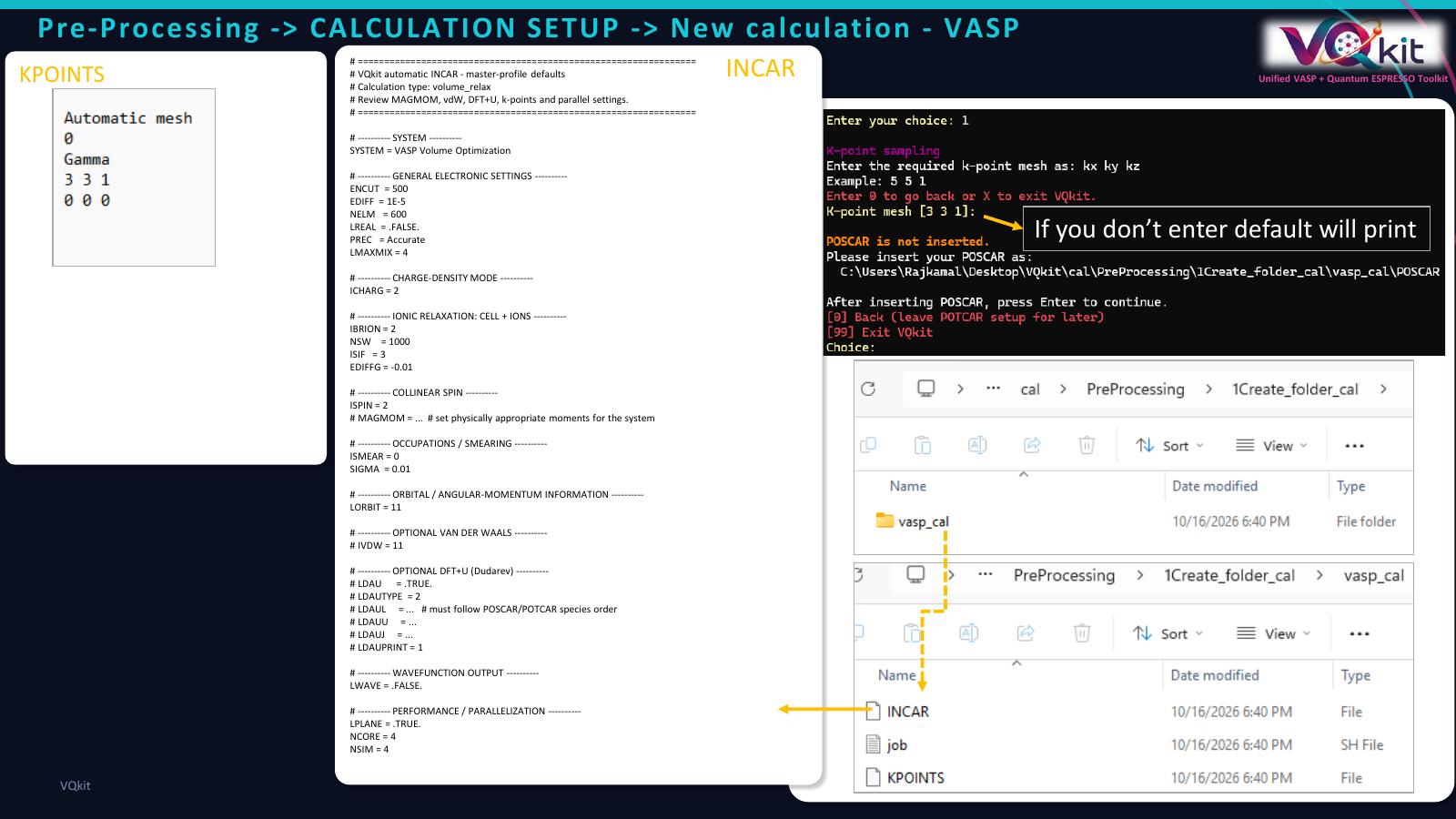
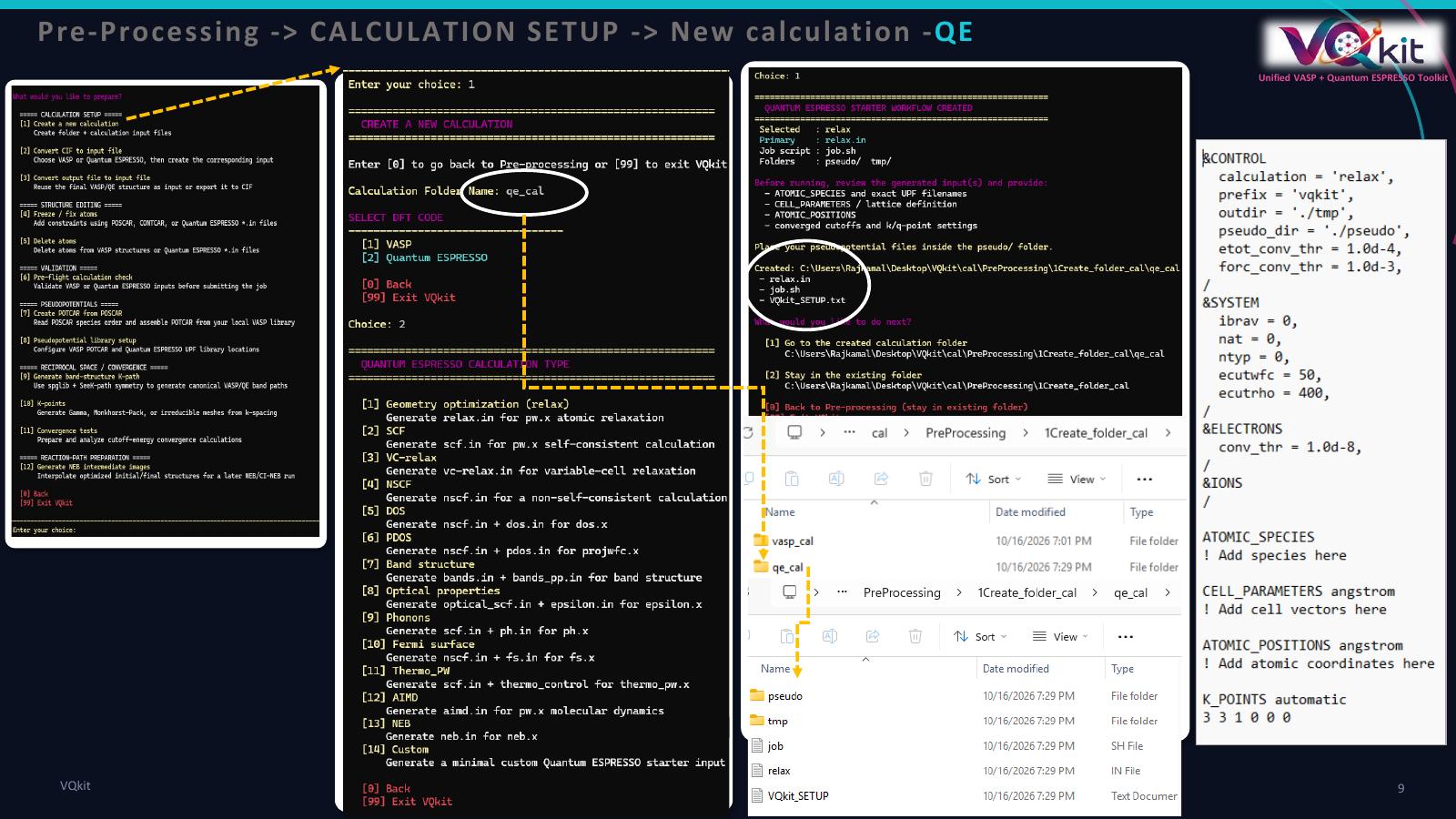
VQkit provides guided workflows for preparing VASP and Quantum ESPRESSO calculations from structures and existing calculation files.

VASP calculation setup

VQkit VASP calculation setup

Quantum ESPRESSO calculation setup

VQkit Quantum ESPRESSO calculation setup

Band-structure preparation

VQkit can prepare symmetry-guided high-symmetry paths for electronic band-structure calculations.
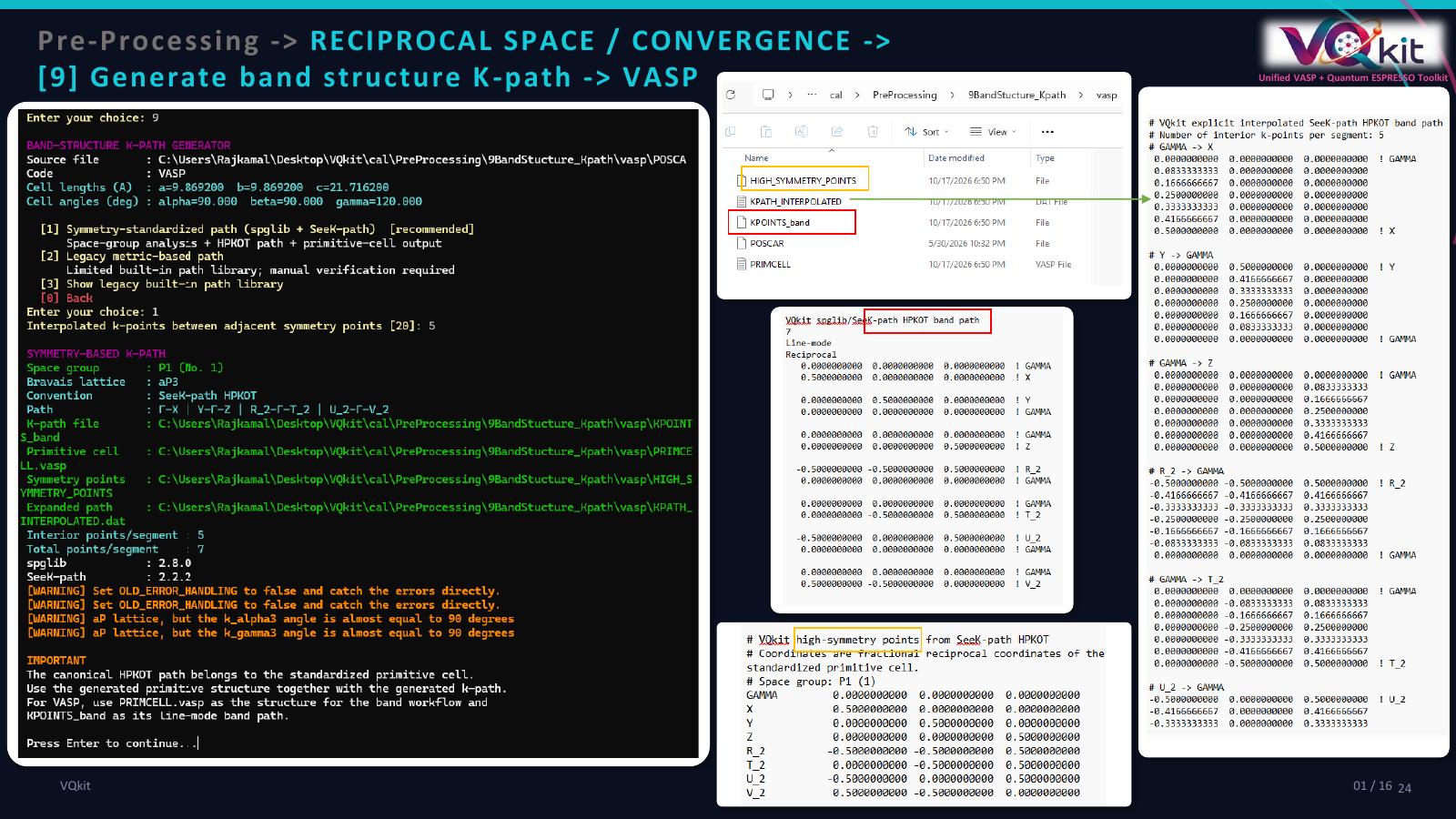
VQkit band-structure path preparation

NEB preparation

Reaction pathways can be prepared through the nudged elastic band workflow, including organization of intermediate images and calculation directories.
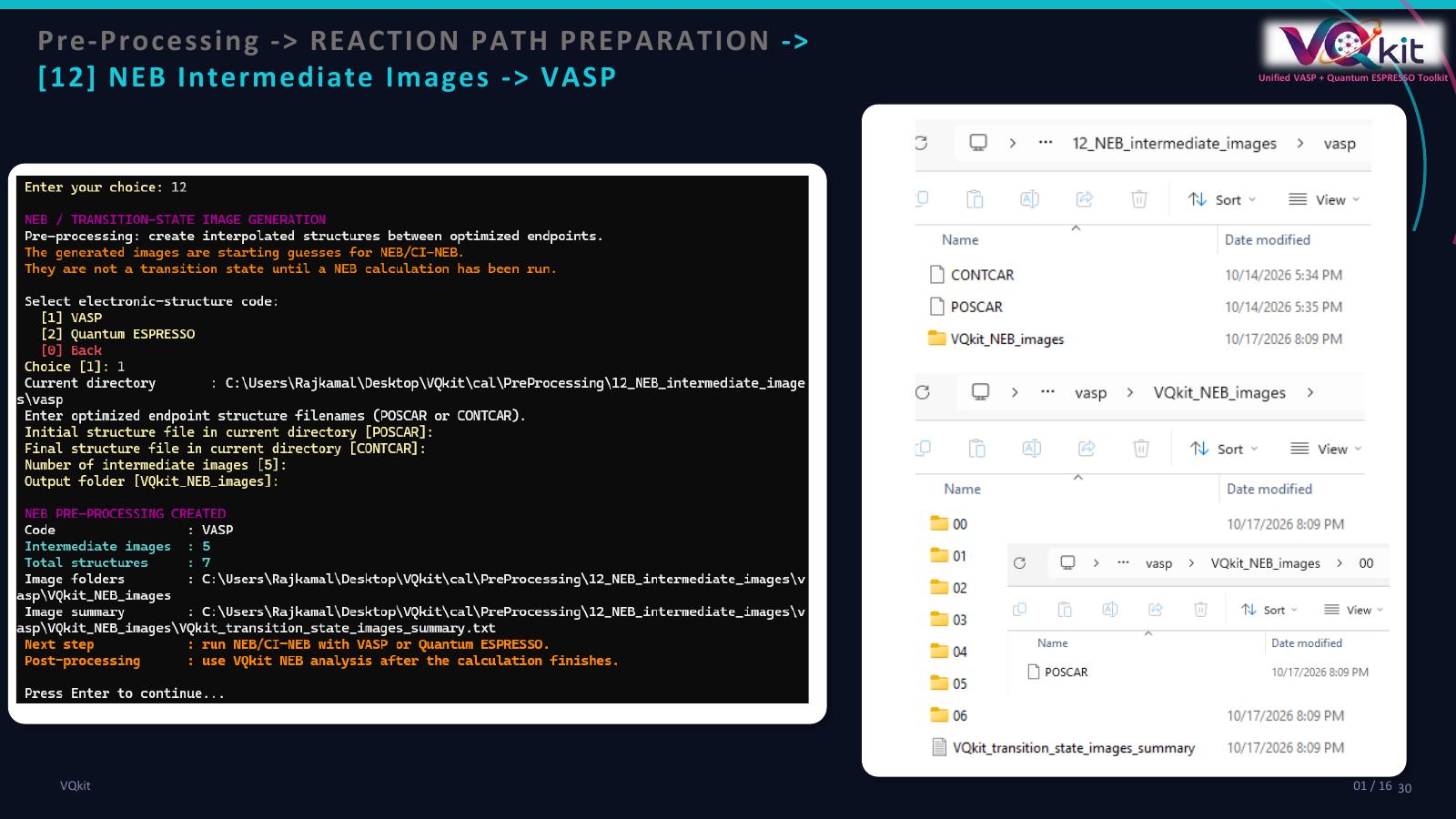
VQkit NEB preparation workflow

Post-processing examples

General calculation analysis

Completed VASP and Quantum ESPRESSO calculations can be inspected through the general calculation-analysis tools.
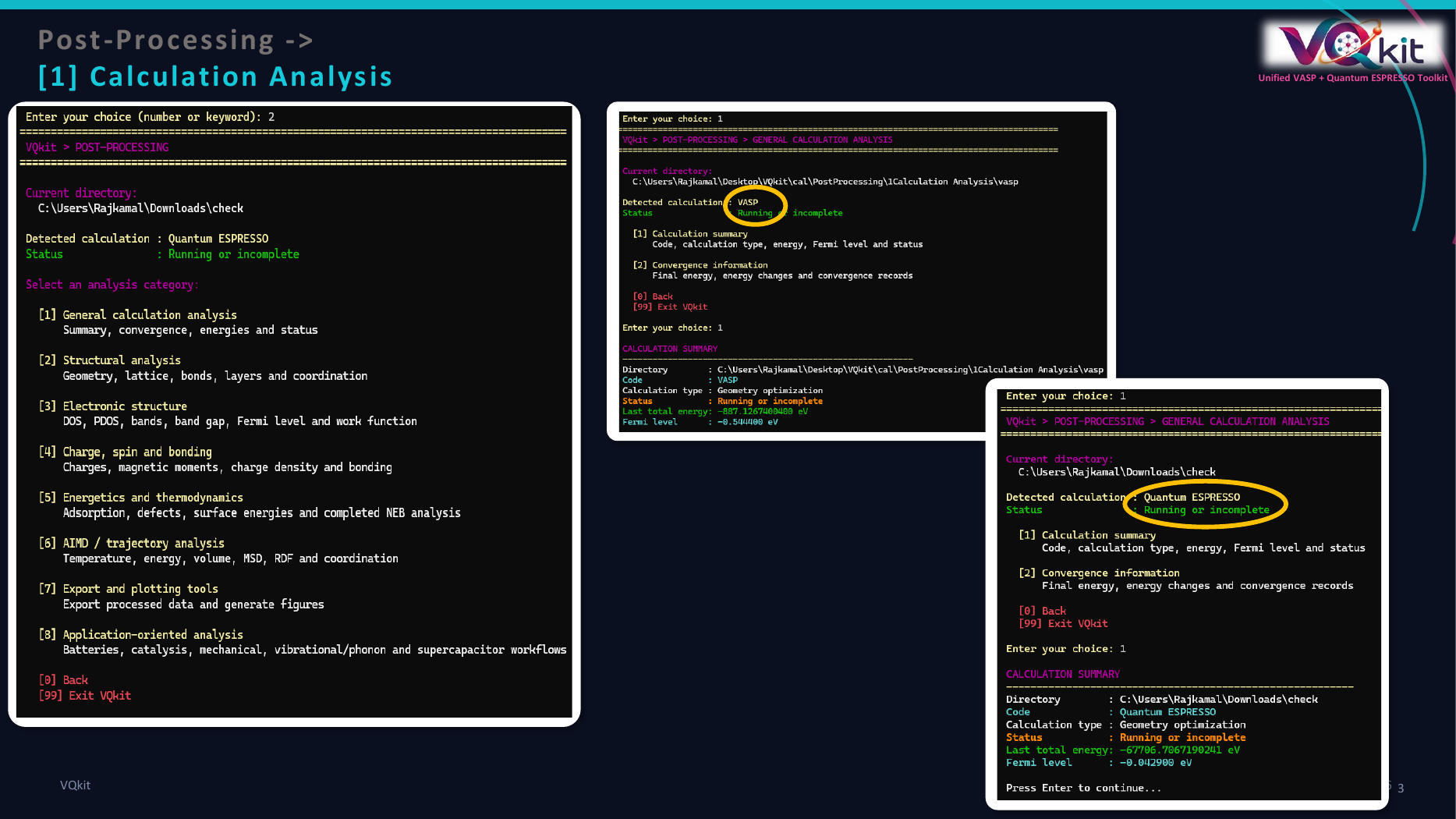
VQkit general calculation analysis

Structural analysis

Structural post-processing provides access to final structures, lattice information, and selected geometry-derived quantities.
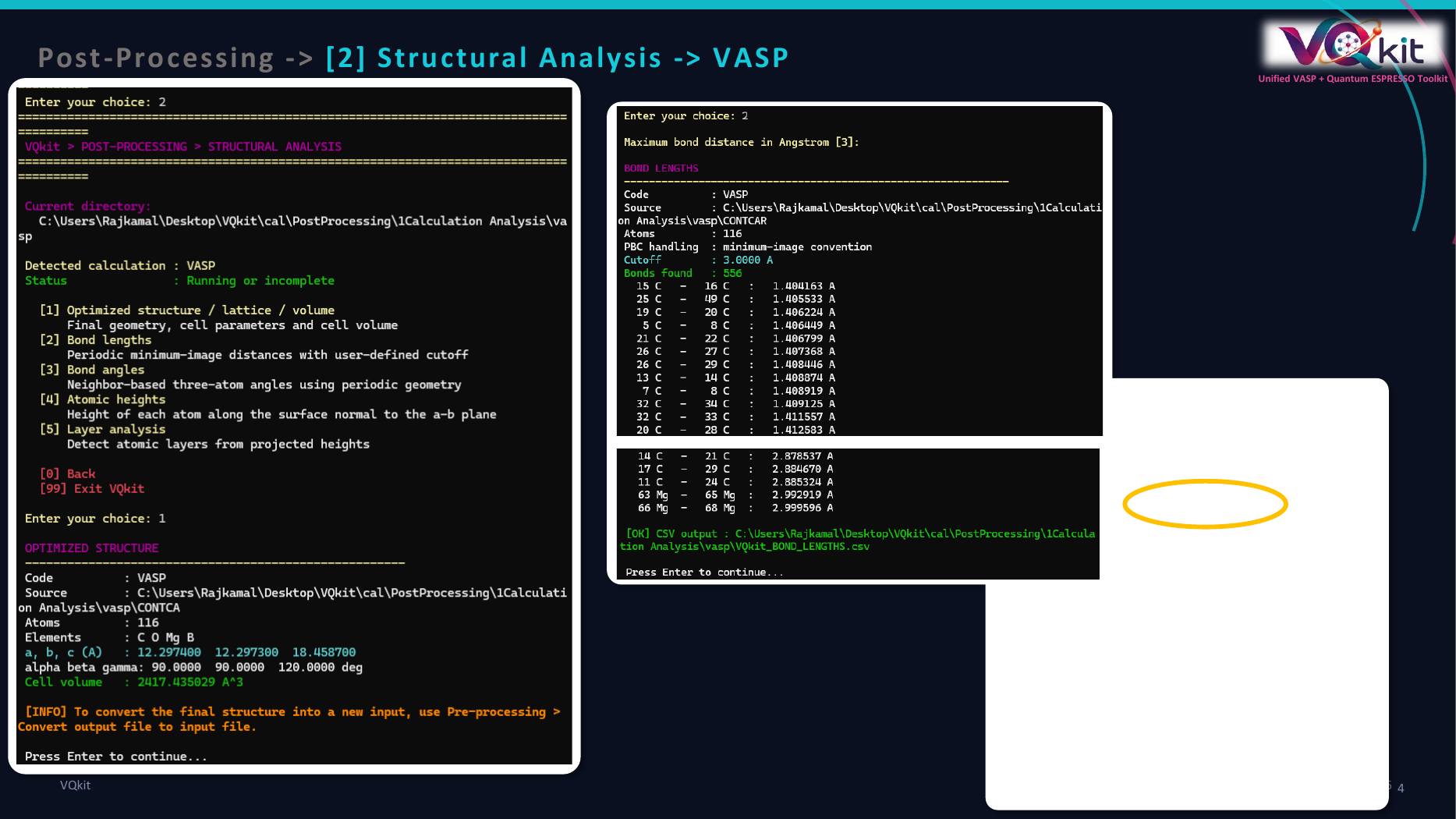
VQkit structural analysis

Electronic structure

Density of states

VQkit supports density-of-states and projected-density-of-states analysis for supported VASP and Quantum ESPRESSO workflows.
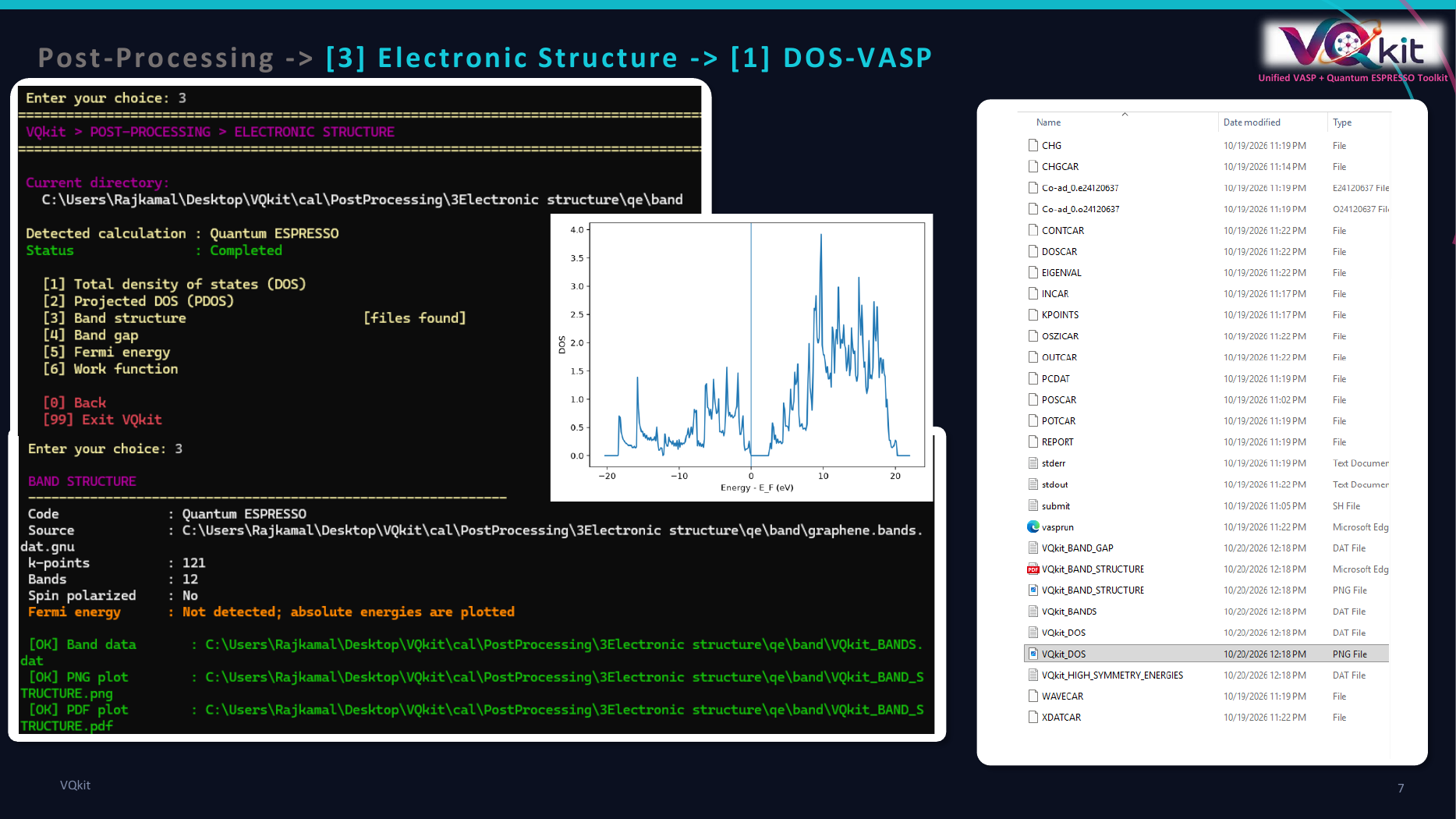
VQkit density-of-states analysis

Band structure

Band-structure workflows provide processed electronic-band information and publication-oriented plots where supported.
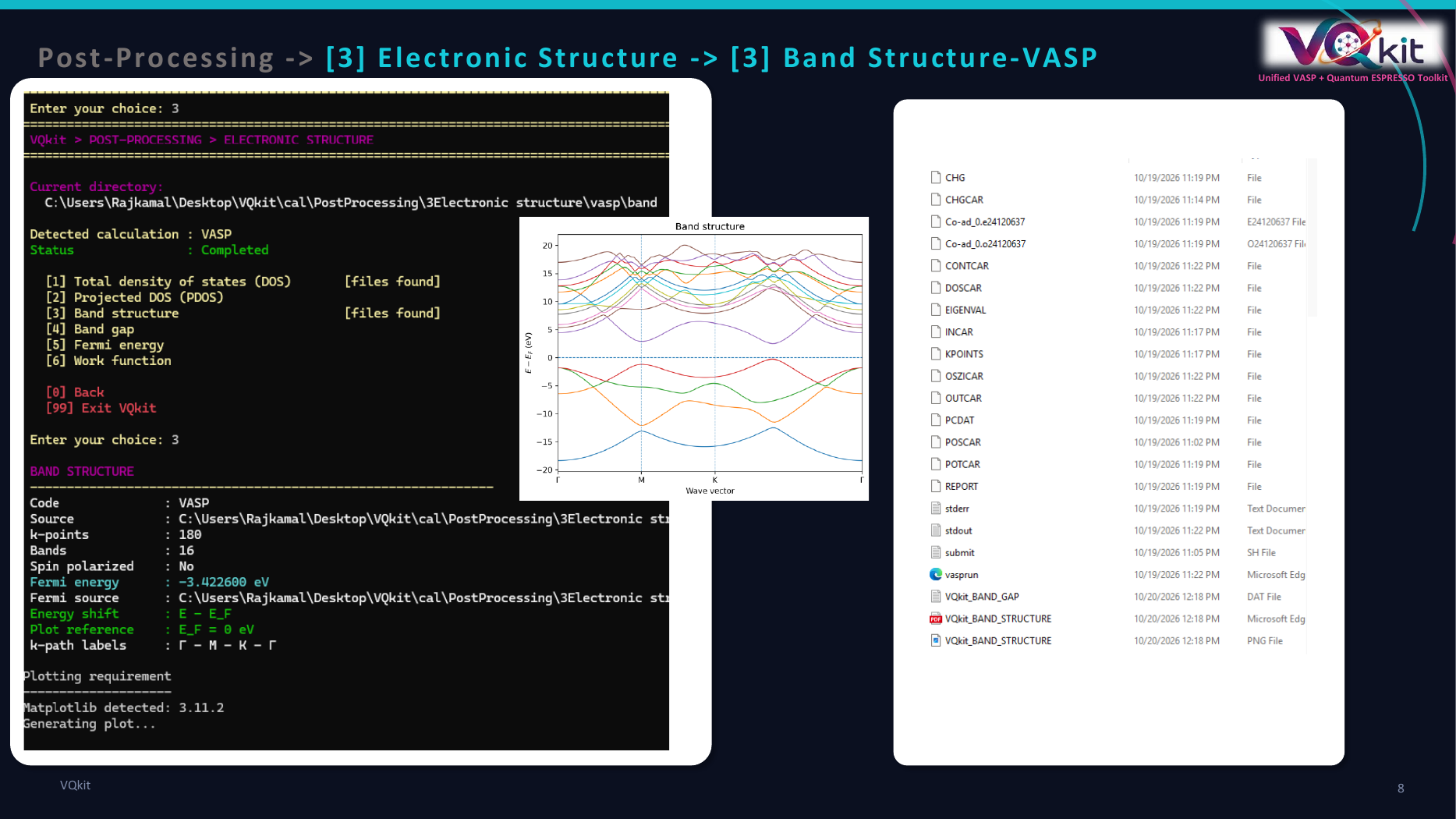
VQkit band-structure analysis

Work function

Surface and interface workflows can be used to evaluate the work function from planar-averaged electrostatic-potential data.
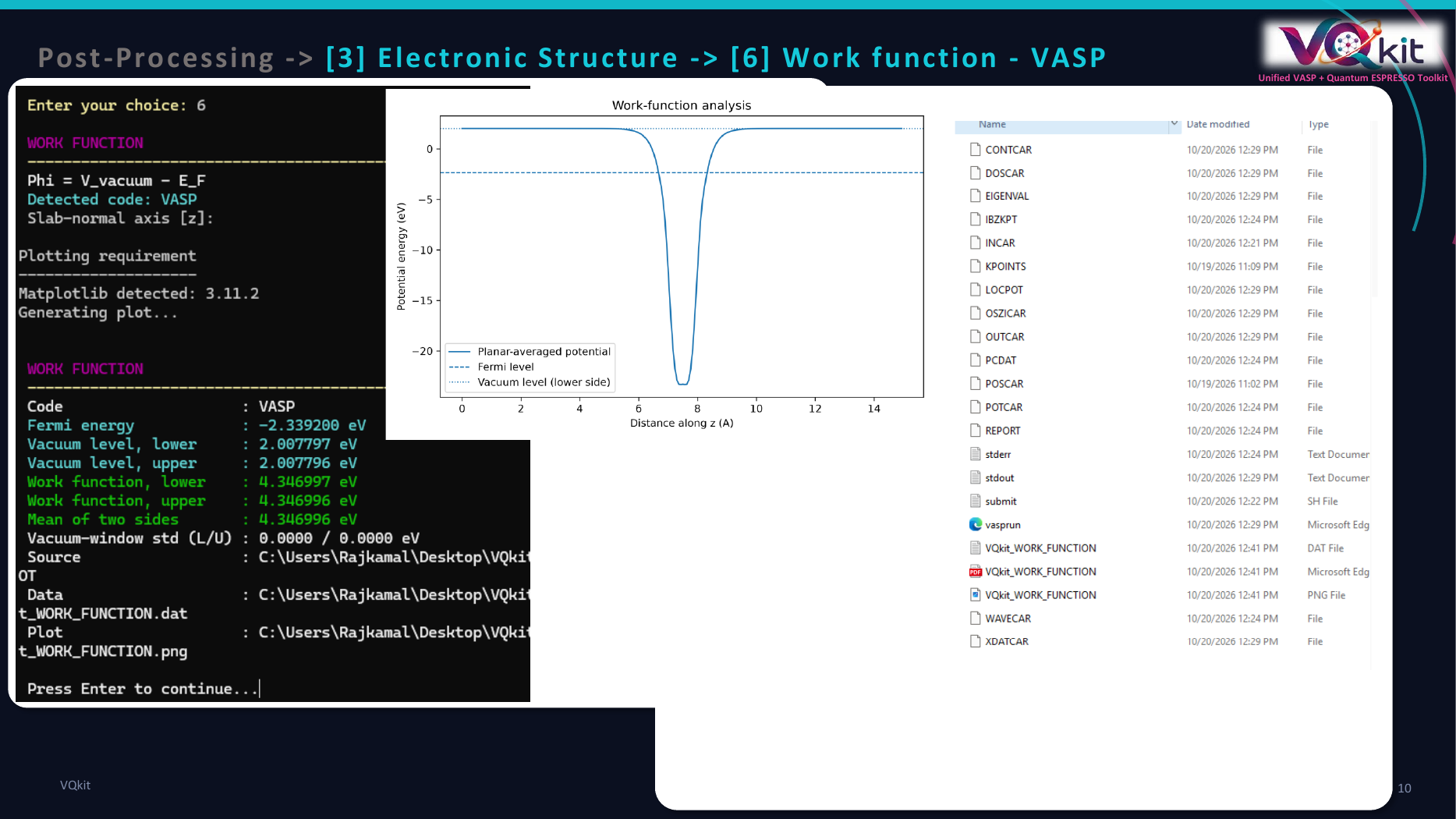
VQkit work-function analysis

Additional gallery topics

The Gallery can be expanded with current VQkit-generated examples for:

  • Projected density of states.

  • Spin-resolved band structures.

  • Charge-density difference maps.

  • Electron localization function maps.

  • Bader charge analysis.

  • AIMD temperature and energy plots.

  • Mean-squared displacement.

  • Radial distribution functions.

  • NEB energy profiles.

  • Mechanical-property summaries.

  • Directional-elasticity 3D surfaces.

  • Phonon-derived transport descriptors.

As VQkit evolves, this page should preferentially use output generated by the current release so that screenshots and plots remain consistent with the latest interface.

Previous Next

© Copyright 2026, VQkit developers.